The DMCC Act for UK online stores: what to change in your ads and reviews
The CMA can now fine online businesses directly, and it has: Wayfair, StubHub, Marks Electrical and more. Here is what they were fined for and what to check in your own ads, checkout and reviews.
SocialPulse Hub team · Updated 16 Nov 2026 · 11 min read
Key takeaways
- Since 6 April 2025 the CMA can fine businesses directly, up to 10% of global turnover or £300,000, whichever is greater. Since April 2026 it says it has imposed over £11.8 million in fines.
- Show the total price, including mandatory fees, from the start, in your ads as well as at checkout.
- Only use countdowns and 'ends tonight' claims when the offer really ends. Wayfair was fined £4.8 million over deals like these.
- No pre-ticked boxes for paid extras, and no fake, hidden-incentive or cherry-picked reviews. The CMA found more than half of 100+ businesses it checked could be failing on reviews.
Since 6 April 2025, the UK's Competition and Markets Authority (CMA) no longer has to go to court to punish a business for breaking consumer law. Under the Digital Markets, Competition and Consumers Act 2024, the DMCC Act, it can decide a case itself and fine up to 10% of global turnover or £300,000, whichever is greater.
For a while that sounded theoretical. It is not anymore. In its October 2026 update, the CMA said that since April 2026 it has "ordered redress of over £2.3 million and imposed fines of over £11.8 million". The businesses it fined were not shady operators. They were well-known retailers whose checkout and promotion habits looked a lot like what many online stores still do.
This guide is for founders of UK online stores, on Shopify or anywhere else, who run ads and collect reviews. It covers the DMCC Act ecommerce rules that matter most for marketing, what the CMA has actually fined businesses for, and a practical list of what to check in your ads, product pages and reviews before 2027. Every fact below links to gov.uk. It is a plain-English summary, not legal advice.
What the CMA has fined online businesses for so far
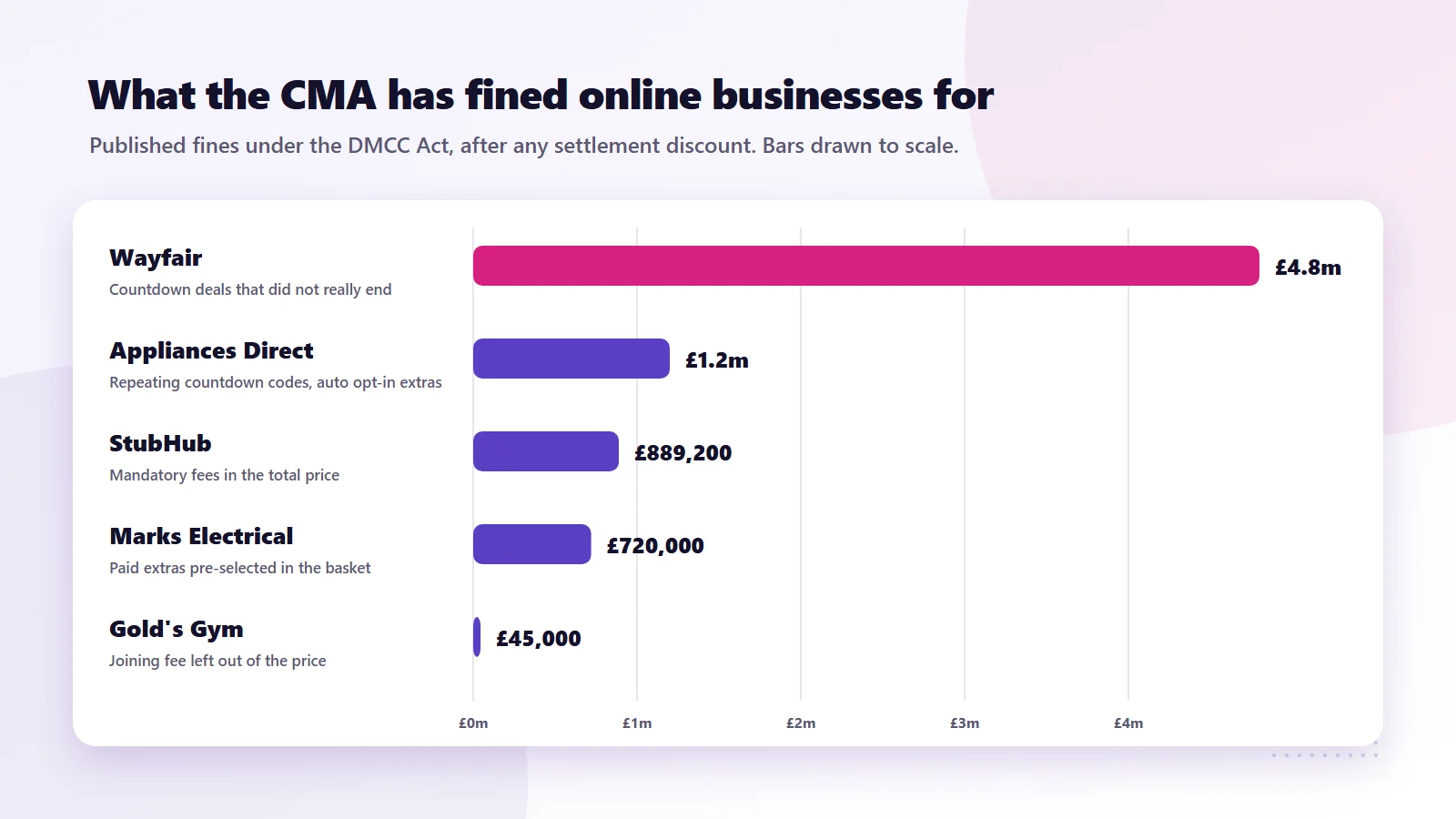
These are the CMA's own published decisions under the new powers. The amounts are the final fines the CMA announced, after any discount for settling the case.
| Business | Fine | What it was about | Refunds ordered |
|---|---|---|---|
| Wayfair | £4.8 million | "Daily Deals" and 24-hour "Flash Deals" with countdown timers, where many products stayed at the same or a lower price after the deadline | Not listed in the announcement |
| Appliances Direct | £1.2 million | Countdown banners with discount codes that kept coming back, and customers opted in automatically to paid extras | About £432,000 |
| StubHub | £889,200 | Whether mandatory fees were included in the total price shown at the start | Mandatory fees refunded |
| Marks Electrical | £720,000 | Paid extras pre-selected in the basket without express agreement | About £600,000 to nearly 40,000 customers |
| Gold's Gym | £45,000 | A mandatory joining fee left out of the total price, or shown unclearly | £9,220 to 726 customers |
Look at the pattern. None of these is exotic. A countdown timer, a pre-ticked add-on, a fee that appears at checkout. The Marks Electrical decision shows how small the individual amounts can be: the final notice says the pre-selected services cost £3.50, £7 or £20, yet customers were charged £601,914 in total over about seven months.
The CMA has also been busy on reviews. In March 2026 it opened investigations into five businesses, including whether one food brand gave customers discounts for 5-star reviews without saying so, and whether some 1-star reviews were left off a platform and out of its star ratings. The CMA says it has not reached any conclusions in those cases, but they show exactly what it is looking at.
The four areas to fix in your marketing
1. Show the total price, from the first moment
The DMCC Act bans showing an initial price and adding mandatory fees later, often called drip pricing. In the CMA's words from its October 2026 fines announcement: "Businesses must show customers the total price, including any mandatory fees, clearly and from the outset."
For an online store, that means:
- Any fee every customer has to pay belongs in the headline price. Service fees, booking fees, "handling" fees and compulsory membership or joining fees are the usual offenders.
- Your ads can count too. Gov.uk's guide to unfair commercial practices says the DMCC Act "includes specific requirements about being transparent with prices in invitations to purchase", and an ad that shows a product and its price can be one. If the price in your Meta ad, Google ad or Shopping feed is lower than what everyone ends up paying, fix the ad or the fee.
- Watch delivery. The CMA said in October 2026 that it is reviewing how online retailers disclose delivery fees and expects to give an update. Make delivery costs easy to find before checkout rather than a surprise at the end.
2. Only claim urgency that is real
Wayfair's £4.8 million fine was about deals that implied urgency when, for many products, the price stayed the same or dropped after the deadline. Appliances Direct was fined partly for countdown banners with discount codes that reappeared over many days.
Before you run any "ends tonight", "24-hour flash sale" or countdown timer, in an ad or on your site, ask one question: will the price really go up when the clock hits zero? If the honest answer is "we'll probably run it again next week", do not use the countdown. The CMA's advice is blunt: "Discounts must be genuine."
The same goes for "was £80, now £49" pricing. The "was" price should be a price you genuinely charged, not a number chosen to make the discount look bigger.
3. No pre-ticked boxes for paid extras
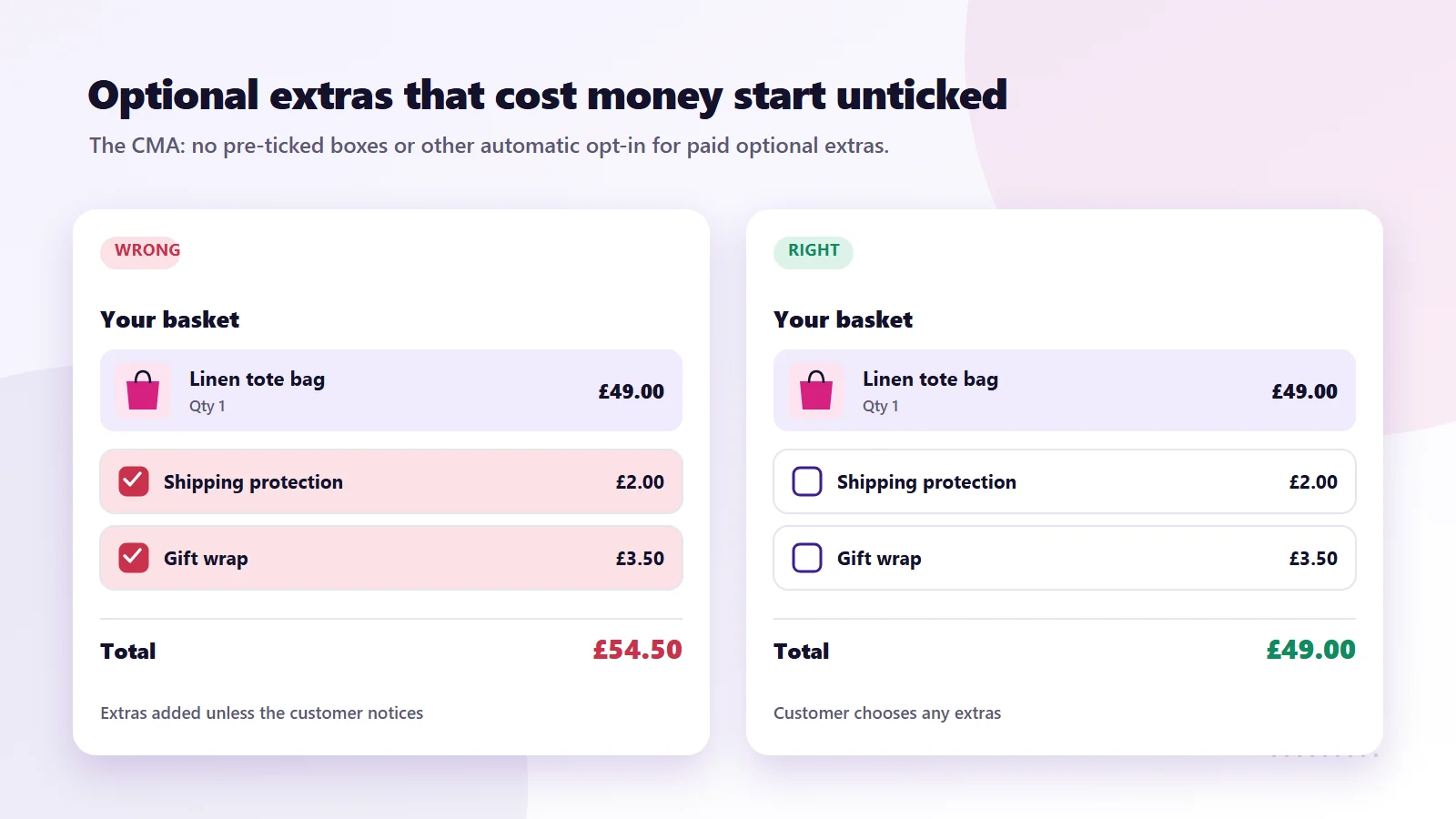
Marks Electrical and Appliances Direct were both fined for opting customers in automatically to extras that cost money. The CMA's message after the Marks Electrical case could not be clearer: "Businesses are not allowed to use pre-ticked boxes or other forms of automatic opt-in for optional extras which cost money."
Check your checkout and your apps for anything added to the basket by default: gift wrap, extended warranties, shipping protection, priority dispatch, donations, recycling or installation. If it costs money and it is optional, the customer has to choose it.
4. Reviews: no fakes, no hidden rewards, no cherry-picking
Fake reviews are now a banned practice under the DMCC Act, which means they are automatically unfair and illegal. The CMA's short guide for businesses lists three kinds of banned content:
- Fake reviews: reviews that look or claim to be genuine but are not. Writing them, or paying someone else to, is banned.
- Concealed incentivised reviews: you can reward customers for a review, but you must say so, and the review must still reflect their genuine experience.
- False or misleading review information: this includes aggregated information, so your star rating and review count have to be honest too.
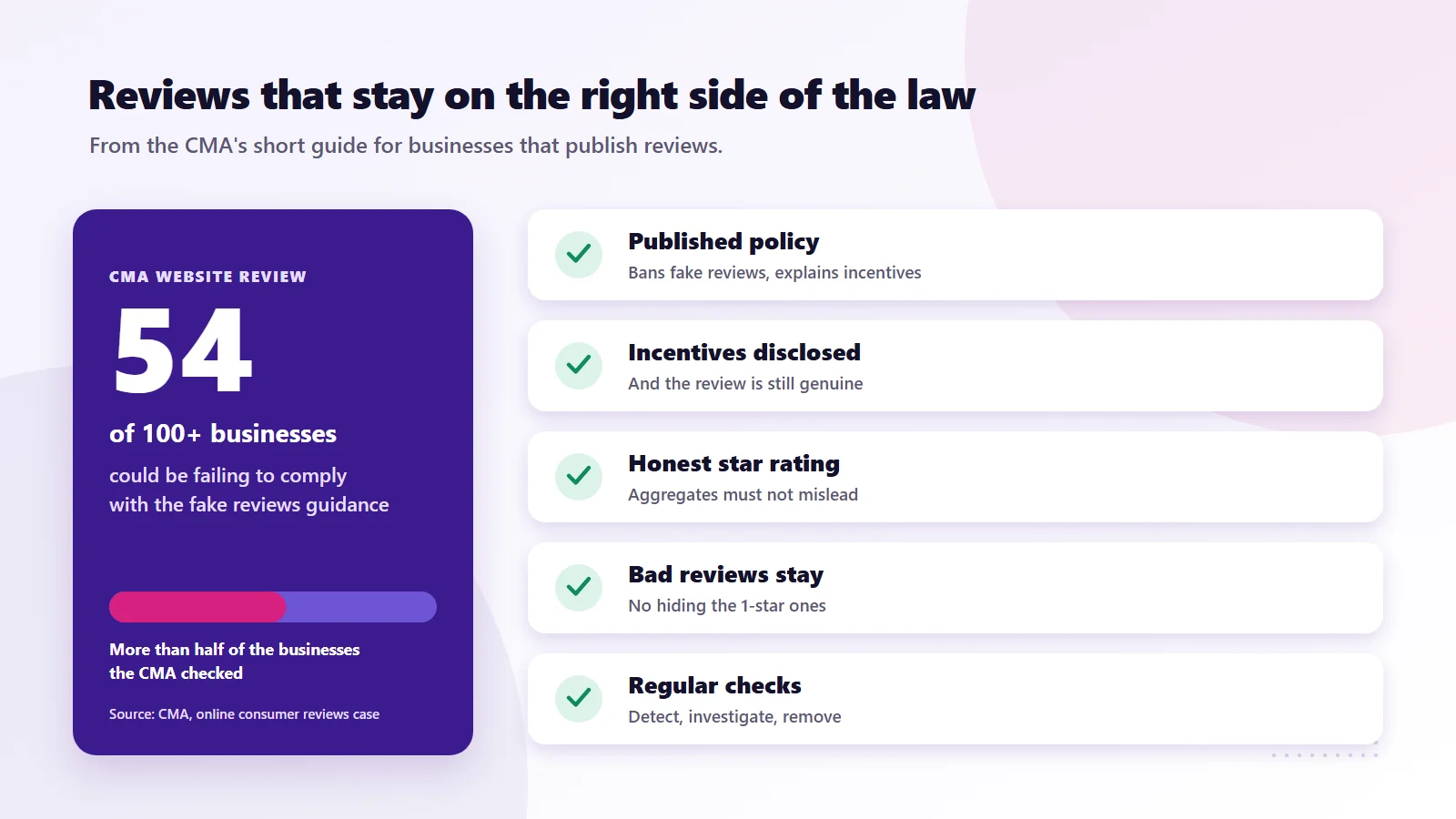
If you publish reviews on your site, the guide says you should have a published policy that clearly prohibits fake reviews and sets out your approach to incentivised reviews, and you must assess the risk of banned content appearing. You are expected to detect, investigate and remove problem reviews.
Removing reviews cuts both ways. The CMA's full fake reviews guidance says a trader "may infringe the law if they suppress genuine negative or positive reviews" or selectively promote the good ones. One of its examples of a banned practice is contacting a customer who left a negative review and offering a refund or gift card if they change it. Remove fake reviews, but keep genuine 1-star reviews in place.
This is where the official data is most striking. When the CMA reviewed the websites of more than 100 businesses, it found that more than half, 54 in total, could be failing to comply. Some had no policy banning fake reviews at all. Others had policies that were "unclear, incomplete or inaccessible".
A quick check for your ads
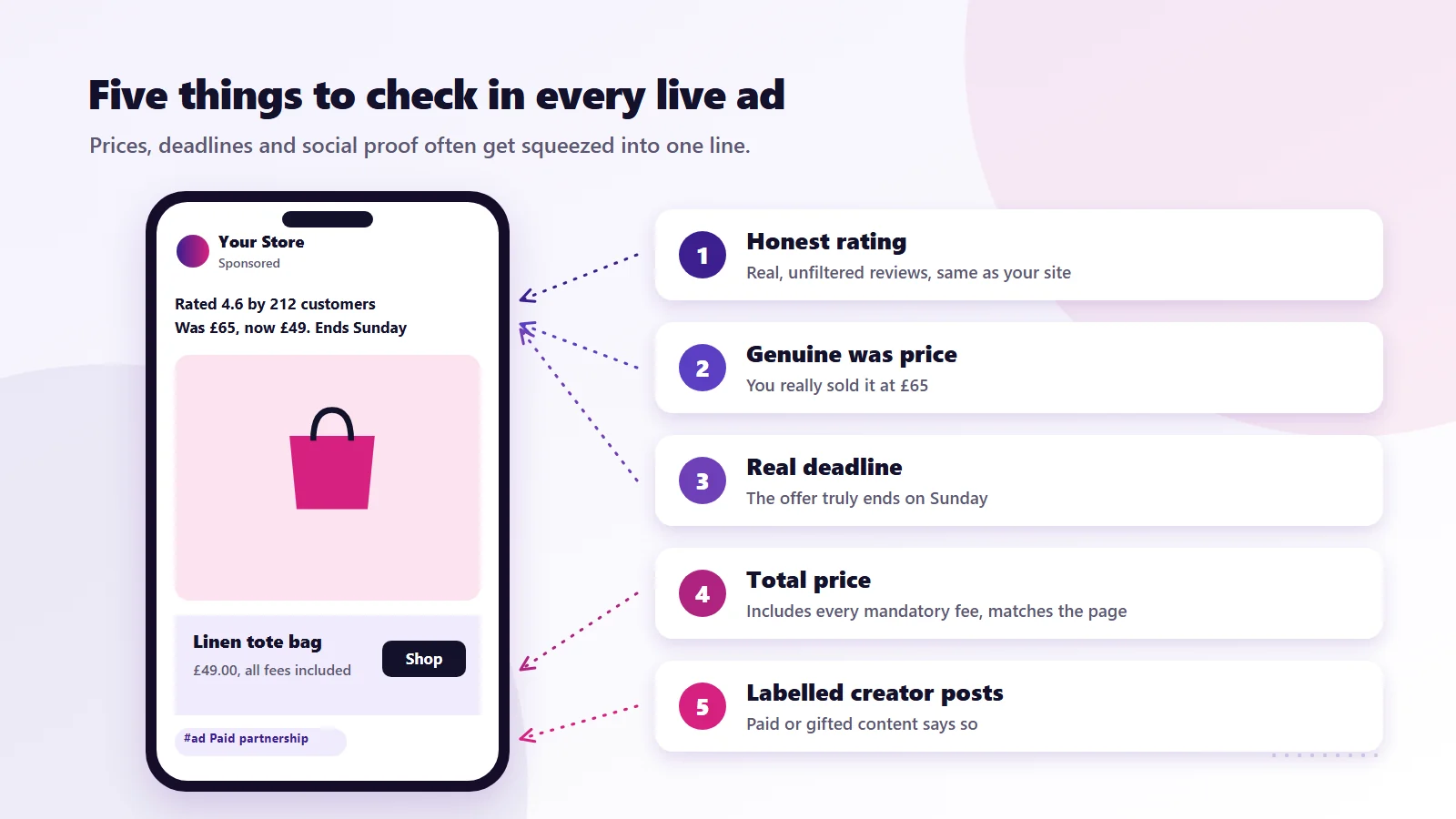
Ads are where many of these rules show up first, because that is where prices, offers and social proof get squeezed into one line. Run every live ad through this list.
| In the ad | Ask yourself |
|---|---|
| A price | Is it the total every customer pays, including mandatory fees? Does it match the product page? |
| "Ends tonight", "Last chance", a timer | Will the offer really end then? |
| "Was / now" or "50% off" | Did we genuinely sell at the "was" price? |
| "Rated 4.8 stars" or "10,000 happy customers" | Does it come from real, unfiltered reviews and match what is on our site? |
| A creator or influencer post | Is it clearly labelled as an ad if we paid for it or gave free products? |
On that last point, gov.uk says businesses must make sure that reviews and online content are genuine and accurate, "and endorsements are made clear". The CMA's reviews and endorsements guidance for businesses and content creators covers how to label paid posts.
If you sell subscriptions, 2027 brings more
The CMA's October 2026 update says a new subscription contracts regime comes into force in January 2027, with secondary legislation and further guidance from the government first. If you sell subscribe-and-save, memberships or boxes, keep an eye on gov.uk for the final rules and plan time to update your sign-up and cancellation journeys.
How big could a fine be?
The legal maximum is 10% of global turnover or £300,000, whichever is greater. That is a ceiling, not a typical number. The Marks Electrical notice shows the CMA calculating a penalty step by step from the business's relevant UK turnover, then adjusting it. When the regime started, the CMA also said it was likely that fines for breaches in the first 12 months would be lower than in the years that followed. That first year ended in April 2026.
The bigger cost for a small store is often not the fine. It is refunding every affected customer, changing your checkout under a deadline, and having the decision published on gov.uk with your name on it.
Common mistakes
- Assuming it only applies to big brands. The maximum is 10% of turnover or £300,000, whichever is greater, so even a small store faces a meaningful ceiling. Gold's Gym's fine was £45,000.
- Leaving app defaults on. Some checkout add-on apps can put items in the basket by default. Check what yours do.
- Reusing "limited time" creative. An offer that runs every week is not limited.
- Hiding or filtering bad reviews. The CMA's guidance warns against suppressing genuine negative reviews. Honest ratings include the 1-star ones.
- Rewarding reviews without saying so. A discount for a review is fine only if it is disclosed and the review is genuine.
- Forgetting the ads. The product page can be perfect while an old ad still shows a lower price or a fake deadline.
How we approach this
When we take on a UK store's ads or SEO, we check offers, prices and review claims against these rules before we write new copy. Clear, honest pricing and genuine reviews are also simply better marketing: shoppers trust them, and they keep working long after a fake countdown would have been noticed. This guide is a summary of official guidance, not legal advice, so for anything specific to your business, check with a legal adviser.
If you want a second pair of eyes on your ads and product pages, see how we run Meta Ads and SEO for online stores, or request a free audit and report using the button below. And if your Meta numbers look off, our guide on why Facebook shows fewer sales than Shopify explains the tracking side, including the UK consent rules.
Frequently asked questions
What is the DMCC Act?
The Digital Markets, Competition and Consumers Act 2024 is a UK law that, among other things, lets the Competition and Markets Authority enforce consumer protection law directly from 6 April 2025. It also adds new banned practices, including fake reviews, and specific rules on showing prices clearly.
How much can the CMA fine a business under the DMCC Act?
Up to 10% of the business's global turnover or £300,000, whichever is greater. That is the maximum. The CMA calculates actual penalties step by step from relevant UK turnover, and the fines in its first online pricing cases ranged from £45,000 (Gold's Gym) to £4.8 million (Wayfair).
What is drip pricing?
Drip pricing is showing an initial price and adding mandatory fees later in the buying process. The CMA says businesses must show the total price, including any mandatory fees, clearly and from the outset.
Are countdown timers illegal in the UK?
Not in themselves, but a countdown that suggests a deal will end when it will not is misleading. The CMA fined Wayfair £4.8 million over Daily Deals and Flash Deals where many products stayed at the same or a lower price after the deadline.
Can I use pre-ticked boxes for optional extras?
Not for extras that cost money. The CMA has said businesses are not allowed to use pre-ticked boxes or other forms of automatic opt-in for optional extras which cost money, and fined Marks Electrical £720,000 for doing so.
Can I give customers a discount for leaving a review?
Yes, but you must clearly disclose that the review was incentivised, and the review must still reflect the customer's genuine experience. Concealed incentivised reviews are a banned practice under the DMCC Act.
Does the DMCC Act apply to small online stores?
Yes. It applies to businesses dealing with UK consumers, whatever their size. The maximum fine is 10% of turnover or £300,000, whichever is greater, and one of the CMA's published fines so far was £45,000.
Have a question about this guide or your own setup? Contact us and our team will get back to you.