Cars.com vs CarGurus for dealers: cost, leads and reach compared
Most Cars.com vs CarGurus comparisons are for shoppers. This one is for dealers: audience, listings and leads, where Autotrader fits, and cost per car sold.
SocialPulse Hub team · Updated 19 Nov 2026 · 9 min read
Key takeaways
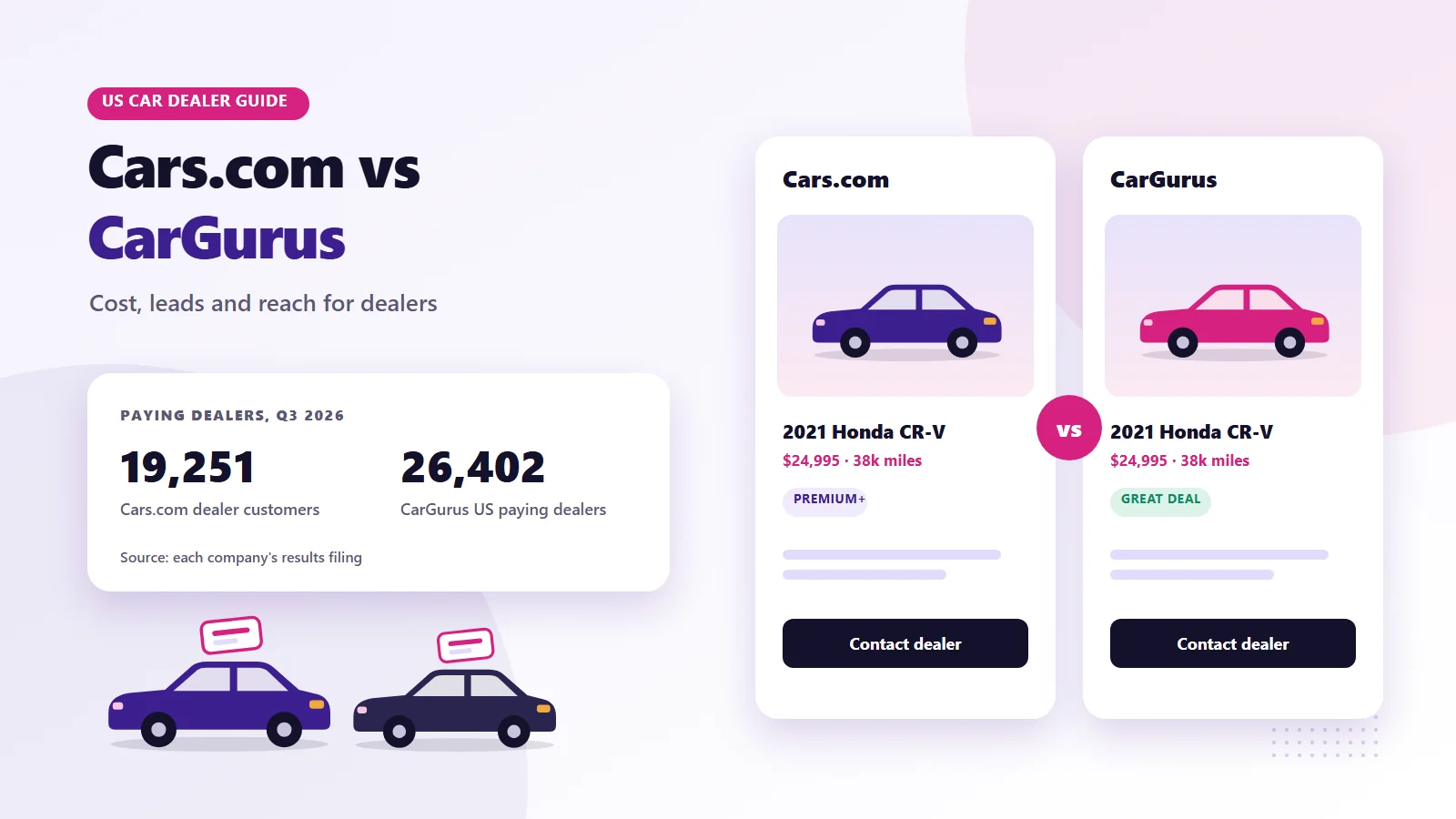
- CarGurus reports 26,402 US paying dealers; Cars.com reports 19,251 dealer customers (Q3 2026, each company's own results).
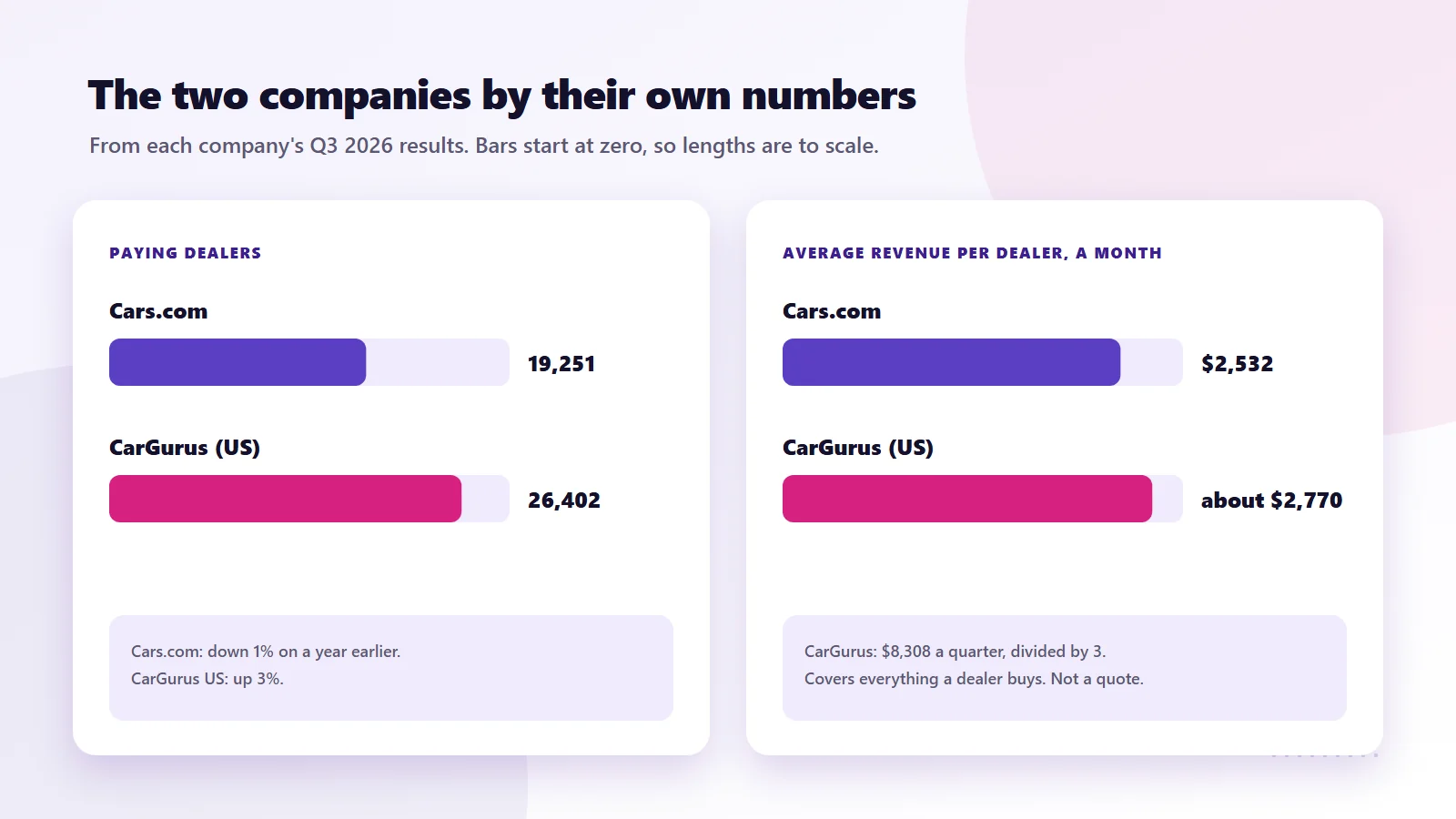
- Neither publishes package prices. Average revenue per dealer is about $2,770 a month at CarGurus (US) and $2,532 at Cars.com, across all their dealer products.
- CarGurus ranks cars by price against market value. Cars.com sells subscription tiers plus website products. Autotrader, owned by Cox, bundles its nVision dashboard into every listings package.
- Judge every site on cost per car sold from your own lead source tracking, then test your own channel next to them.
Search "cars.com vs cargurus" and the results tell shoppers where to find a cheaper car. If you run a lot, the question is different: which site sells more of your cars for less money, and how dependent should you be on either?
Every figure below comes from the company's own results filing or its own dealer pages, checked on 19 November 2026. Where a company does not publish a number, we say so.
Cars.com vs CarGurus at a glance
| Cars.com | CarGurus | Autotrader (US) | |
|---|---|---|---|
| Dealers paying | 19,251 dealer customers (Q3 2026, down 1% on a year earlier) | 26,402 US paying dealers (Q3 2026, up 3%) | Not published |
| Audience | 24.7 million average monthly unique visitors (Q3 2026) | Says it is the most visited listings site (Similarweb, Q4 2025) | Over 28 million visitors a month, per Cox Automotive |
| Average revenue per dealer | $2,532 a month, across all dealer products | $8,308 a quarter in the US (about $2,770 a month), mainly subscriptions | Not published |
| Package prices | Not published; quoted per dealer | Not published; quoted per dealer | Not published; quoted per dealer |
| Free option | Marketplace Starter, self-service and non-paid | Restricted listings, with limits such as 6 photos per car | None stated |
| How cars stand out | Higher subscription tiers, such as Premium+ | Deal Rating: your price against its Instant Market Value | Paid ad products such as Advanced Ads and Spotlight Ads |
| Reporting | Ask for a sample report before signing | Dealer Dashboard with lead reports | nVision dashboard in every listings package |
What Cars.com and CarGurus cost a dealer
Neither company lists package prices on its site. Both quote per dealer, and the quote depends on your stock count, market and the tier you pick. The closest public numbers are in their results filings.
- Cars.com averaged $2,532 a month per dealer in Q3 2026, up 3% on a year earlier. That figure covers its dealer products, which include Dealer Inspire websites as well as Marketplace listings. Its higher Premium+ tier reached 12% adoption in the quarter.
- CarGurus averaged $8,308 per US paying dealer for the quarter, up 7%. Divided by three, that is about $2,770 a month, mainly from subscription products.
Both have a free way in. Cars.com launched a self-service Marketplace Starter package that nearly 400 independent dealers took up in Q3 2026. CarGurus has Restricted listings, which limit you to 6 photos per car and limit the leads you can see. CarGurus says its paid Enhanced tier brings 4 times more unique leads per vehicle than Restricted. That is its own claim.
Before you sign with either, ask for three things in writing: the monthly price, the notice period to cancel or drop a tier, and what you lose (photos, lead details, placement) if you step down.
Leads, deal ratings and what they mean for your stock
The biggest practical difference is how each site decides which cars shoppers see first.
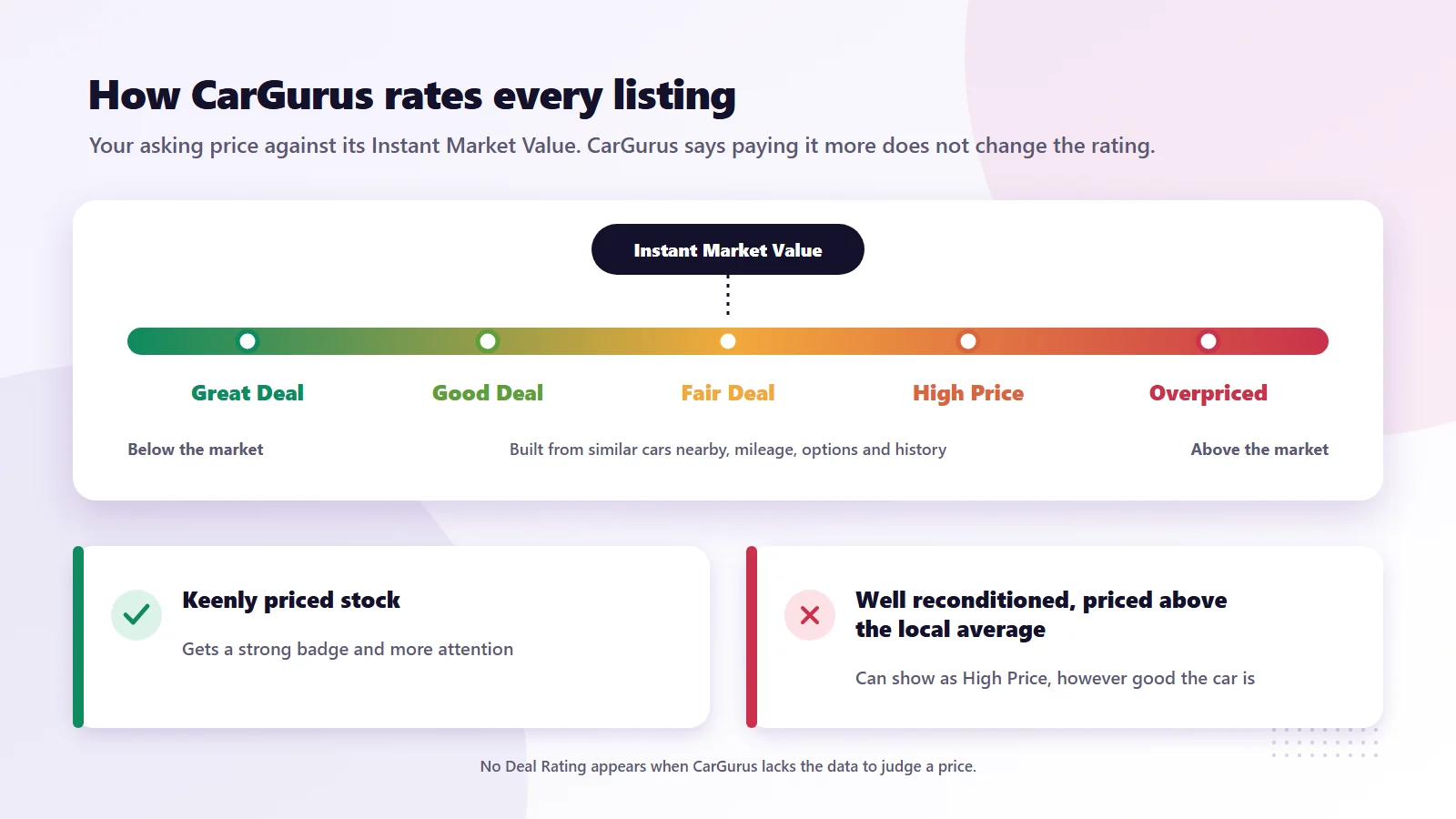
CarGurus gives every listing a Deal Rating: Great Deal, Good Deal, Fair Deal, High Price or Overpriced, or No Deal Rating when it lacks data. The rating compares your asking price with its Instant Market Value, an estimate built from similar cars nearby, mileage, options and history. CarGurus says what you pay it does not change the rating, and that the rating looks at price only.
For a dealer, that cuts both ways. Keenly priced stock gets a strong badge and more attention. A car you have reconditioned well, priced above the local average, can show as High Price however good it is.
Cars.com leans on subscription tiers: dealers on higher packages such as Premium+ get more visibility, and its results credit higher-tier uptake for marketplace growth. Cars.com also reports more than 1 million monthly users for Carson, its AI shopping assistant, which is one more place your stock can surface.
Lead quality is where your own data matters most. Both sites send calls, emails, texts and chats. Which of those turn into sales depends on your stock, your prices and how fast your team replies, so the only reliable comparison is your own.
Autotrader vs CarGurus, and Autotrader for dealers
Autotrader in the US belongs to Cox Automotive, which also owns Kelley Blue Book. Cox says over 28 million people visit Autotrader each month. Every Autotrader listings package includes nVision, Cox's performance dashboard, and current subscribers have most of their listings syndicated to the Car and Driver marketplace as part of their package.
Autotrader also sells paid ad products on top of listings, such as Advanced Ads and Spotlight Ads. Like the other two, it does not publish package prices.
So Autotrader vs CarGurus comes down to the same test: if you already use Cox tools, the bundled reporting and Kelley Blue Book reach may suit you. If your stock is priced to the market, CarGurus' Deal Rating may work harder for you. Track both before you decide.
If you sell in the UK, Autotrader there is a separate company with its own pricing. We compared it with Facebook ads in Autotrader or Facebook ads?
Compare them on cost per car sold
Cost per lead flatters the site that sends the most enquiries, even if they rarely buy. Cost per car sold is the number that matches your bank account:
- Tag every lead by source in your CRM or DMS: Cars.com, CarGurus, Autotrader, your website, Facebook, walk-in.
- Tie each sale back to the lead that started it. Ask buyers where they saw the car if the record is not clear.
- Divide each site's monthly bill by the cars it sold that month. Use three months to smooth out a slow week.
Work out your cost per car sold
Enter one site's monthly bill, its leads and your close rate on them. It shows your cost per car sold and the cars our Meta Ads plan must sell to match.
Then test the alternative most marketplace comparisons leave out: buyers who come straight to you. If listing fees keep rising, our guide to CarGurus alternatives for independent dealers covers the other channels worth testing.
Your own channel: buyers who message you directly
Marketplaces rent you an audience. Your own website and ads on Meta or Google bring buyers to you, and every one of those leads stays in your CRM. Meta's automotive inventory ads can show your whole stock list to local buyers and to people who viewed your cars; our setup guide covers the feed, the pixel and the first campaign.
Here is what one dealer client of ours saw. Auto Experts, a car dealer in Pune, India, ran Meta ads that opened a WhatsApp chat with its sales team. In one city, 8,074 buyers started a chat, at $0.07 each from $543 of ad spend, all shown in its own Meta Ads Manager. Indian ad costs are far lower than US costs, so expect a much higher cost per chat in the US. The point is the route: one tap from an ad to a conversation with your team.
Auto Experts, a SocialPulse Hub client: 8,074 buyer chats from $543 of Meta ad spend
A fair test runs your own channel next to the listings for about 12 weeks, with every lead tagged by source. Keep the marketplace that wins on cost per car sold, and move budget only when your own numbers show it.
If you would like help with that test, see how we run Meta Ads for dealerships.
Frequently asked questions
Is Cars.com or CarGurus better for car dealers?
Neither wins for every lot. CarGurus reports more US paying dealers (26,402 against 19,251 dealer customers at Cars.com in Q3 2026) and ranks listings by price against market value, which suits keenly priced stock. Cars.com sells subscription packages and website products alongside listings. Run both on lead source tracking and keep the one with the lower cost per car sold.
How much does CarGurus cost for dealers?
CarGurus does not publish package prices. Its Restricted tier is free with limits, such as 6 photos per vehicle. Paid tiers are Enhanced, Featured and Featured Priority. Its Q3 2026 results show average US revenue per paying dealer of $8,308 a quarter, about $2,770 a month, which covers all its subscription products, not one listing package.
How much does Cars.com cost for dealers?
Cars.com does not publish package prices. Its Q3 2026 results show average revenue per dealer of $2,532 a month, which includes website and other dealer products as well as listings. It also launched a free, self-service Marketplace Starter package that nearly 400 independent dealers took up in the quarter.
Autotrader vs CarGurus: which is better for dealers?
Autotrader, owned by Cox Automotive, says over 28 million people visit each month and includes its nVision reporting dashboard in every listings package. CarGurus says it is the most visited listings site and rates every car by price. Package prices for both are quoted per dealer. Compare them on cost per car sold from your own lead source data.
Do CarGurus deal ratings depend on what a dealer pays?
CarGurus says a dealer's relationship with it does not change the Deal Rating. The rating compares your asking price with its Instant Market Value for similar cars nearby, from Great Deal to Overpriced. It looks at price only, so reconditioning and condition do not raise it.
How should a dealer compare listing sites?
Divide each site's monthly cost by the cars it sold for you that month. That needs lead source tracking in your CRM or DMS, so every sale is tied back to the site that sent the buyer. Cost per lead alone misleads, because lead quality and close rates differ by site.
Have a question about this guide or your own setup? Contact us and our team will get back to you.