Autotrader or Facebook ads? How a used car dealer can compare the two
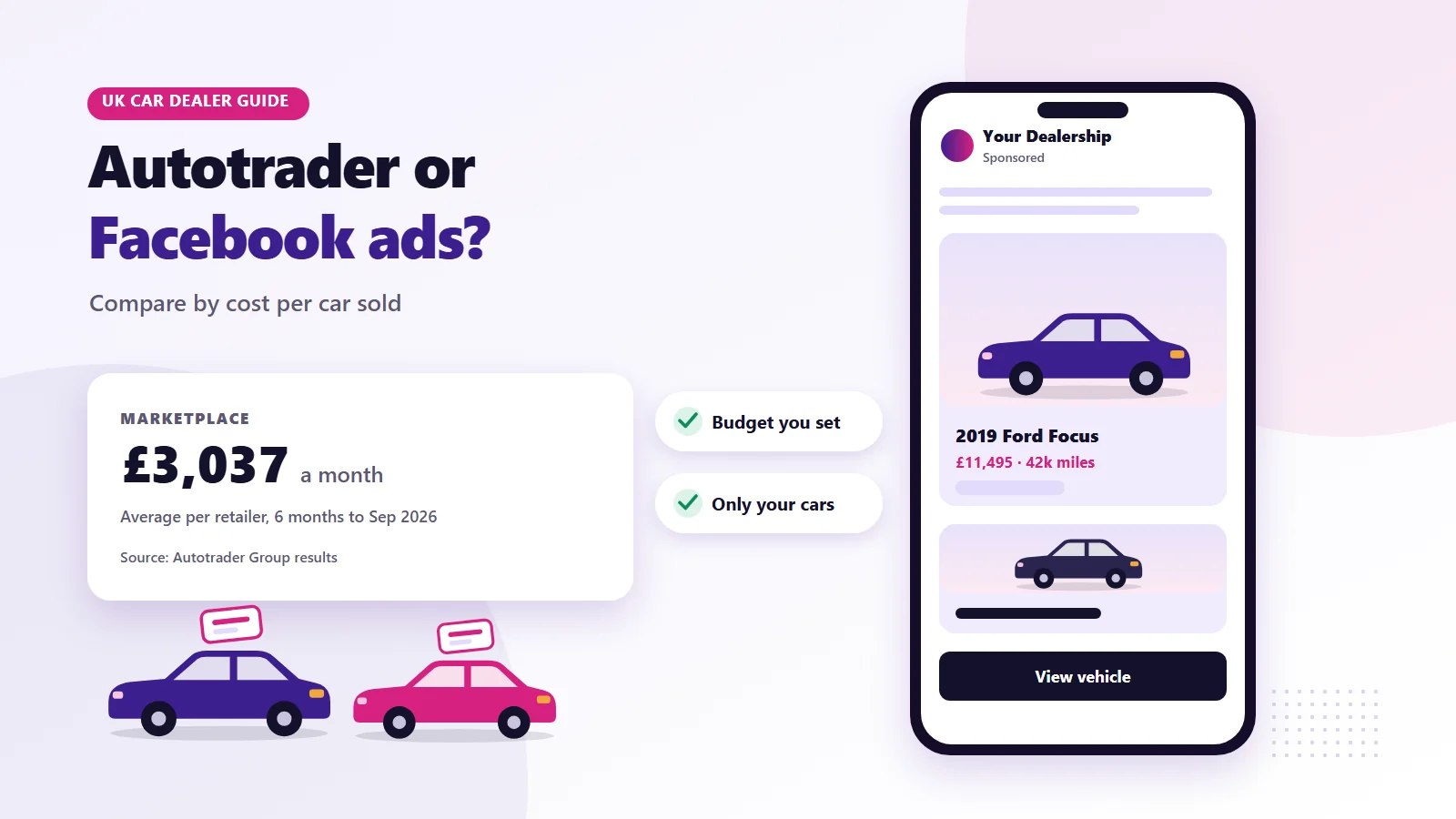
The average retailer now pays Autotrader £3,037 a month, by the company's own figures. Here is how Facebook ads differ, and how to test them alongside Autotrader using cost per car sold.
SocialPulse Hub team · Updated 16 Nov 2026 · 7 min read
Key takeaways
- Autotrader's own results show the average retailer paid £3,037 a month in the six months to September 2026, with prices reviewed every April.
- Autotrader reaches people already searching. Facebook inventory ads reach local buyers earlier and bring back people who viewed your cars.
- Compare the two on cost per car sold, not cost per lead. You need reliable lead source tracking first.
- Test Facebook alongside Autotrader for about 12 weeks, then decide with your own numbers.
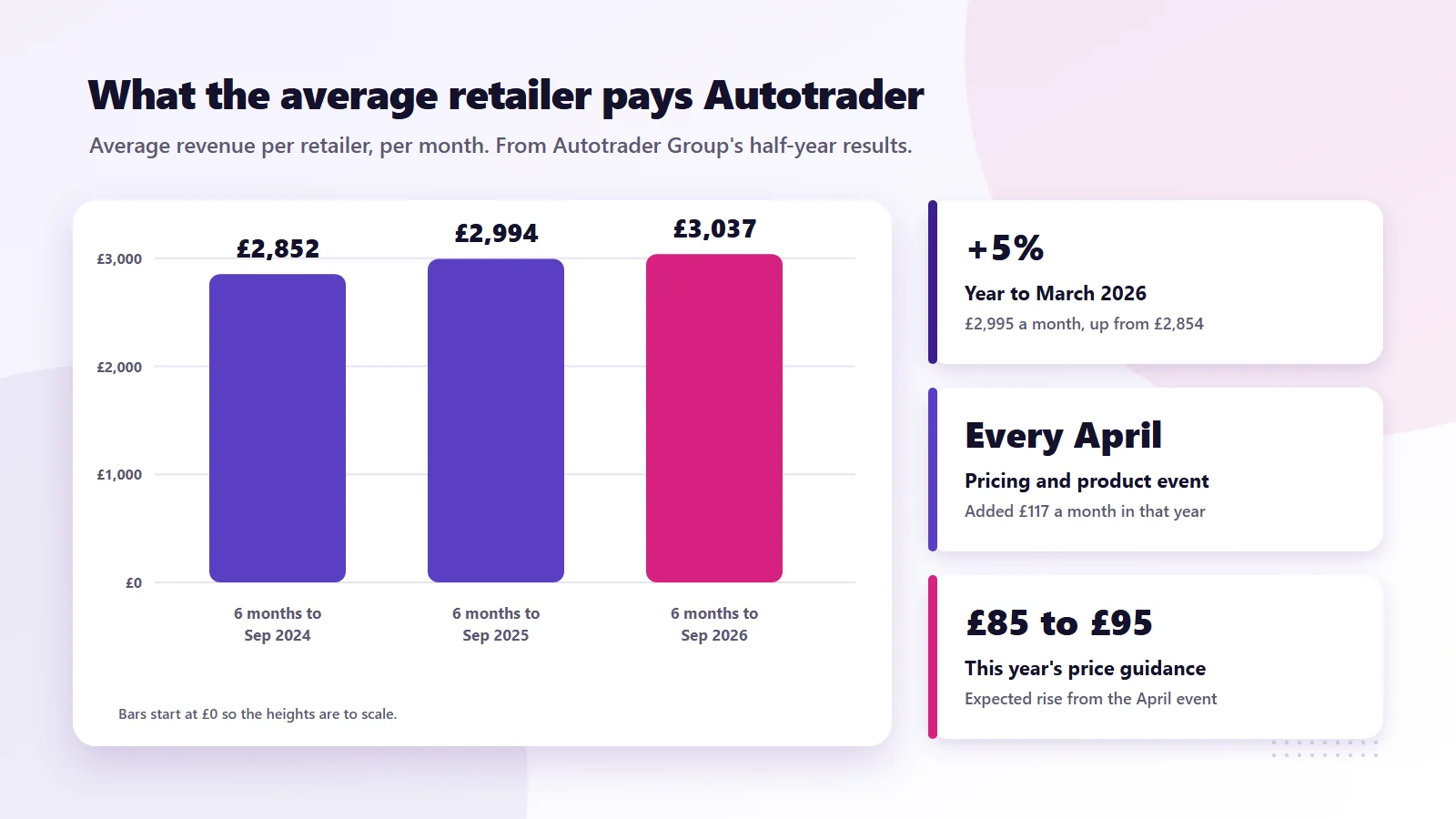
If your Autotrader invoice feels bigger every spring, the company's own results show why. In its half-year results to 30 September 2026, Autotrader Group reported that the average retailer paid it £3,037 a month, up from £2,994 a year earlier and £2,852 the year before that. Over a full year, that is more than £36,000 for the average retailer.
The rises are built into the model. Autotrader's full-year results for the year to 31 March 2026 describe an "annual 1 April pricing and product event", which added £117 a month to average revenue per retailer that year. For the current year, Autotrader guided that its pricing event would add another £85 to £95.
None of this means Autotrader is a bad deal. Autotrader says buyers spend 12 times more time on it than on its nearest competitor, and for many UK used car dealers it remains a core source of buyers. The real question for a dealer principal is different: if you put some of that budget into Facebook and Instagram ads, would you sell more cars for the money? This guide shows how to compare the two fairly, using your own numbers.
It is written for independent UK used car dealers with roughly 20 to 200 cars, who already advertise on Autotrader and are wondering whether Facebook ads for car dealers deserve a test on their own forecourt.
Autotrader vs Facebook ads: how they actually differ
Autotrader and Facebook are not two versions of the same thing. One is a marketplace where people go to search for a car. The other puts your cars in front of people while they scroll, based on who they are and what they have looked at.
| Autotrader | Facebook and Instagram ads | |
|---|---|---|
| How you pay | Monthly package. UK average £3,037 a month in the six months to September 2026 (company figure) | Ad spend you set yourself, as a daily or lifetime budget |
| Price changes | Annual pricing and product event each April | You change your budget whenever you want |
| Who sees your cars | People actively searching the marketplace | People in your area, matched to your stock by Meta's ad system |
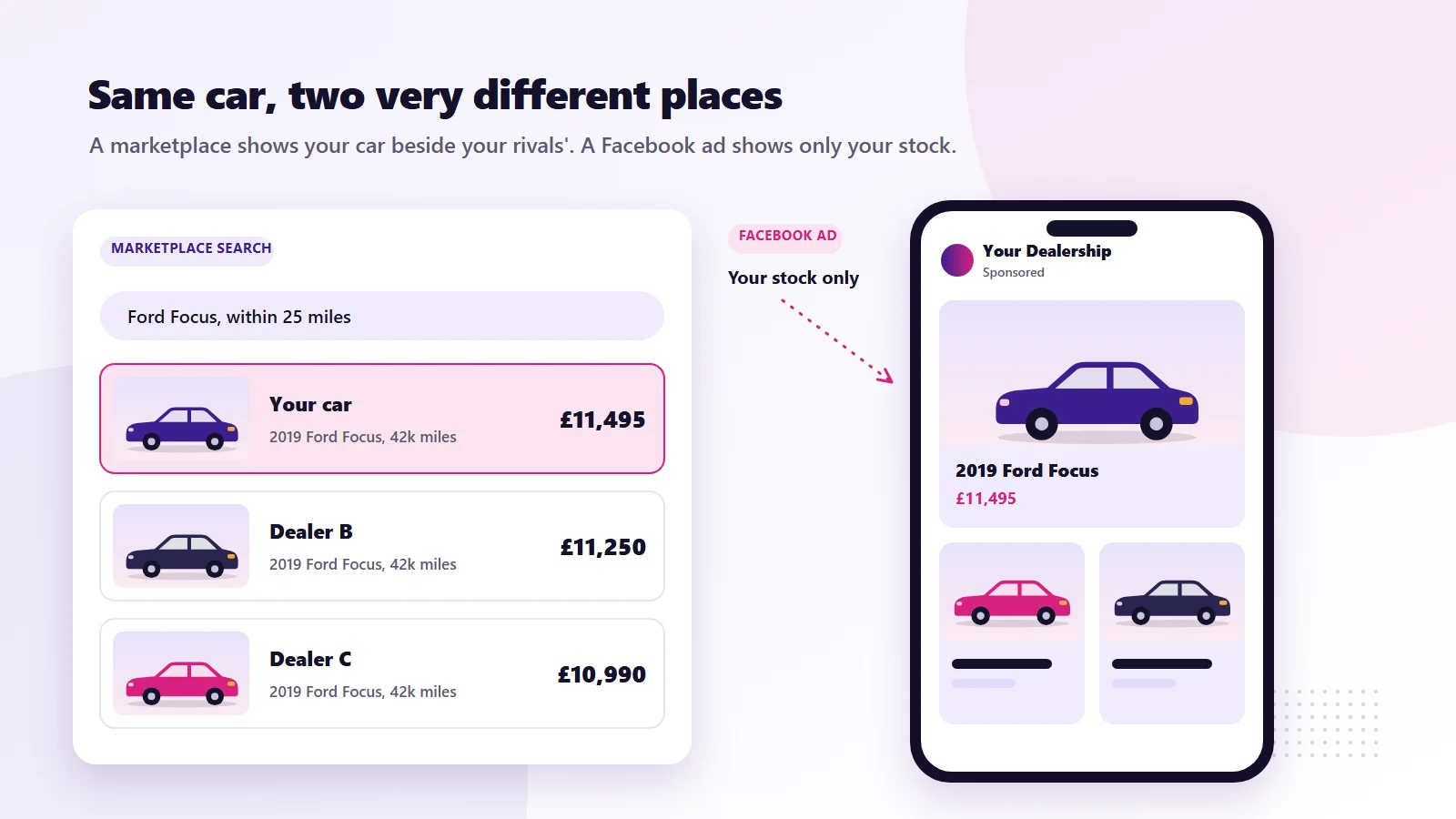
| What they see | Your car next to similar cars from other dealers | Only your cars, in a carousel or single ad |
| Where the click goes | Your listing on Autotrader | Your own website, or a vehicle page on your Facebook Page |
| Stopping | Depends on your contract | Pause campaigns whenever you choose |
On the budget point, Meta's rules are precise. With a daily budget, spending on any single day won't be more than 175% of your daily budget, and over a week ending Saturday at midnight it won't be more than 7 times your daily budget. So a £30 a day budget can never cost more than £210 in a week.
What each one is good at
Where Autotrader is strong
- Buyers who are ready to compare. Someone browsing a car marketplace is often already in the market and narrowing down.
- A very large audience. By Autotrader's own measure, buyers spend 12 times more time on it than on its nearest competitor.
- Little to manage. Your stock goes onto a platform buyers already use, without you building campaigns, audiences or ad creative.
Where Facebook ads add something
- People who have not started searching yet. Meta's automotive inventory ads use your vehicle catalogue, the Meta pixel on your website and people's activity on Meta's apps to show your cars "to the most relevant people". That reaches local buyers before they reach any marketplace.
- Bringing back people who looked and left. Someone who viewed a car on your website can see that exact car again on Facebook or Instagram.
- Your cars only. There is no price ranking against the dealer down the road inside your ad.
- Your own website gets the visit. Every click builds traffic and data you keep, rather than renting it.
The weakness is effort. Facebook ads need a vehicle feed, a catalogue, a working pixel and someone to watch the numbers. Our step-by-step guide on setting up Facebook inventory ads for a used car lot covers all of it.
The only fair comparison: cost per car sold
Comparing Autotrader's leads with Facebook's clicks tells you very little. Leads from a marketplace and leads from social ads behave differently. The number that cuts through is the cost of each car you actually sold from each channel.
| What to collect for each channel, every month | Where it comes from |
|---|---|
| Total cost (package, ad spend, any fees) | Invoices and Ads Manager |
| Leads: calls, forms, chats, messages | Autotrader dashboard, Ads Manager and your CRM |
| Appointments | Your CRM or showroom diary |
| Cars sold, matched to where the buyer came from | Your DMS or sales log |
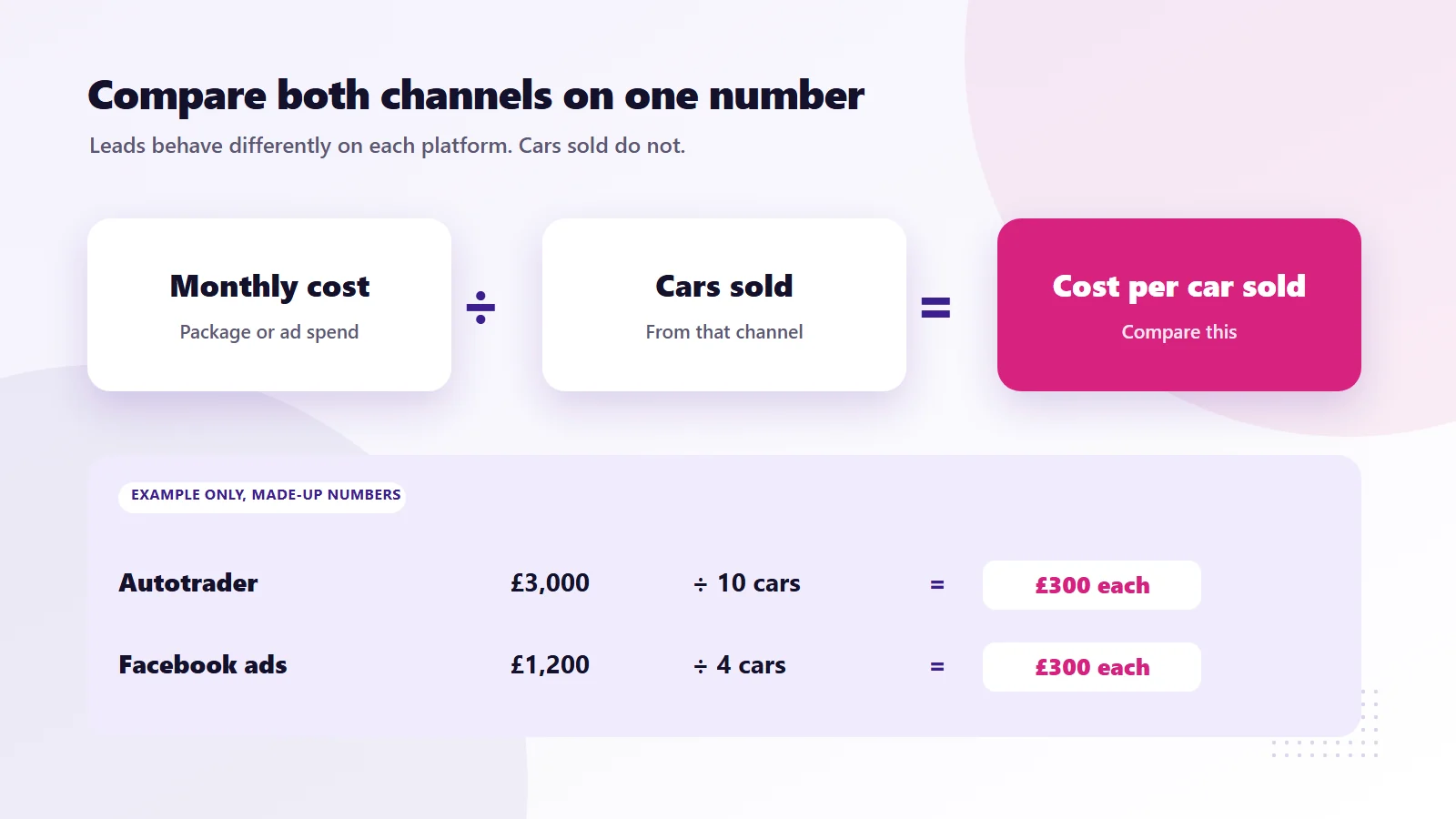
Here is an example, with made-up numbers purely to show the maths:
| Example only | Autotrader | Facebook ads |
|---|---|---|
| Monthly cost | £3,000 | £1,200 |
| Leads | 90 | 40 |
| Cars sold | 10 | 4 |
| Cost per car sold | £300 | £300 |
In this example both channels cost the same per car, which would tell you Facebook is worth keeping alongside Autotrader, not instead of it. Your own numbers could point either way. That is exactly why you measure rather than guess.
If your team does not record where every buyer came from, fix that first. A simple "how did you find us?" field on every deal is enough to start.
How to test Facebook ads without risking your sales
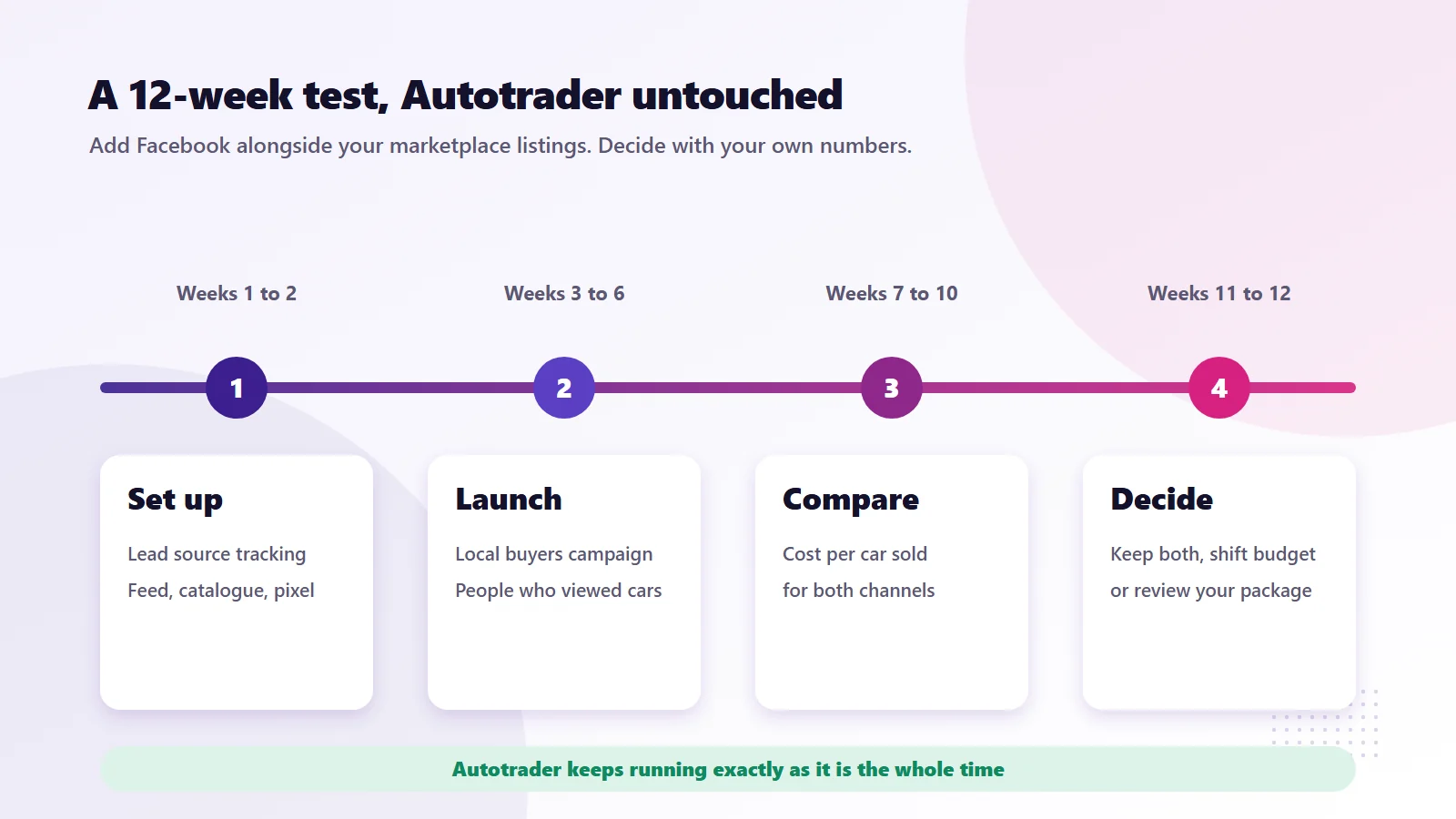
The safest test keeps Autotrader running as normal and adds Facebook alongside it. Twelve weeks is long enough to see real sales, not just early clicks.
| Weeks | What to do |
|---|---|
| 1 to 2 | Add lead source tracking to your CRM. Set up your vehicle feed, Meta catalogue and pixel |
| 3 to 6 | Launch two campaigns: local buyers within a sensible radius, and people who viewed your cars. Keep Autotrader exactly as it is |
| 7 to 10 | Compare cost per car sold for both channels, month by month |
| 11 to 12 | Decide: keep both, shift budget, or review your Autotrader package with real numbers in hand |
Walking into your Autotrader renewal knowing what a car sold through Facebook costs you is a very different conversation from walking in with nothing to compare.
A note on finance offers
Many dealers want to advertise monthly payments on Facebook. In the UK, that wording is a financial promotion. The FCA's guidance on financial promotions on social media makes clear that its rules apply on social media just as they do anywhere else. Have any finance wording checked by whoever handles your FCA compliance before it goes into an ad.
Common mistakes when comparing the two
- Cancelling Autotrader to "see what happens". You lose sales and learn nothing clear. Test alongside it.
- Comparing leads, not cars sold. A cheap Facebook lead that never answers is not cheap.
- Judging Facebook after two weeks. Give it enough time to build up retargeting audiences and sell some cars.
- Sending ads to your homepage. Every vehicle ad should land on that vehicle's own page.
- A stale feed. Sold cars and old prices in your feed waste money and annoy buyers.
- Slow replies. Facebook leads go cold just as fast as Autotrader leads. Answer in minutes.
How this has worked for us
Across the dealership accounts we have worked on, Meta campaigns built on this kind of setup have brought in more than 1,100 leads. Every forecourt is different, and results depend on your stock, prices, location, photos and how quickly your team responds. What stays the same is the method: track properly, test alongside what already works, and let your own numbers decide.
If you want help, see how we run Meta Ads for dealerships, or request a free audit and report using the button below. If you also list on other marketplaces, our guide to CarGurus alternatives uses the same cost per car sold method.
Frequently asked questions
How much does Autotrader cost for dealers?
Autotrader quotes packages per retailer, but its half-year results to 30 September 2026 show the average retailer paid £3,037 a month, up 1% on a year earlier. In the year to March 2026 the average was £2,995 a month, up 5%. Your own package may cost more or less.
Is Facebook cheaper than Autotrader for car dealers?
It can be, but the only fair test is cost per car sold. Facebook lets you set your own daily or lifetime budget, and Meta says spending will not exceed 7 times your daily budget in a week. Whether that sells cars more cheaply depends on your stock, area and follow-up.
Should I cancel Autotrader and use Facebook ads instead?
Not before you have tested. Keep Autotrader running, add Facebook ads alongside it for around 12 weeks, and compare cost per car sold for each. You may well end up using both, with budgets set by your own numbers.
What are Facebook automotive inventory ads?
They are Meta's catalogue-based ads for dealers. They use your vehicle catalogue, the Meta pixel on your website and people's activity on Meta's apps to show your cars to the most relevant people, and can send them to your website or to vehicle details on your Facebook Page.
Why does Autotrader get more expensive every year?
Autotrader runs an annual pricing and product event each April. In the year to March 2026 its price lever added £117 a month to average revenue per retailer, and it guided a further £85 to £95 for the following year.
Can I advertise car finance on Facebook in the UK?
Yes, but finance wording such as monthly payments is a financial promotion. The FCA's guidance confirms its rules apply on social media, so have any finance wording checked by whoever handles your FCA compliance before it runs.
Have a question about this guide or your own setup? Contact us and our team will get back to you.