GEO vs SEO: what changes, what stays the same, and where AEO fits
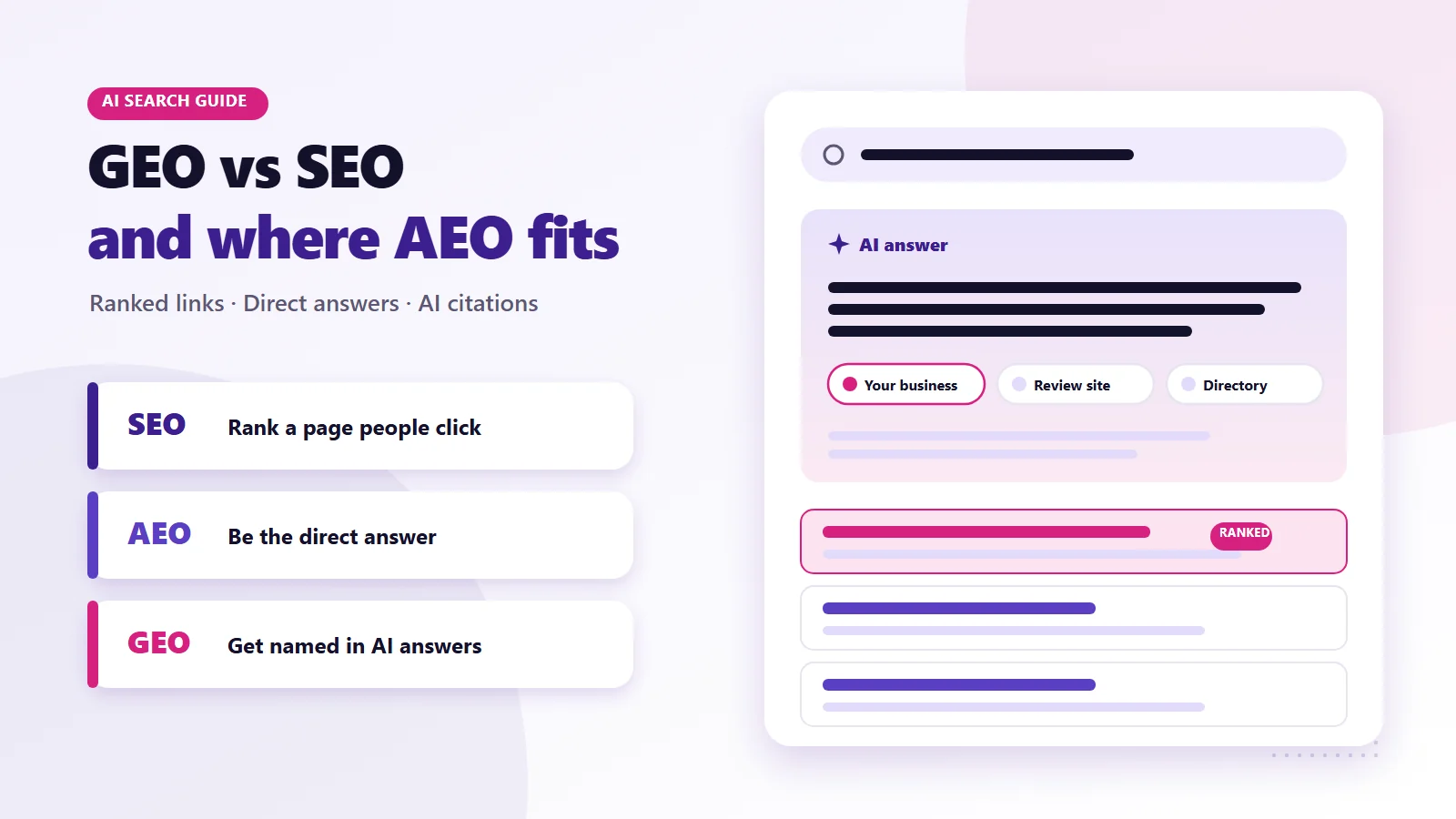
SEO gets your pages ranked in search. GEO (generative engine optimization) gets you quoted in AI answers from ChatGPT, Gemini, Perplexity and Google's AI Overviews.
SocialPulse Hub team · Updated 19 Nov 2026 · 7 min read
Key takeaways
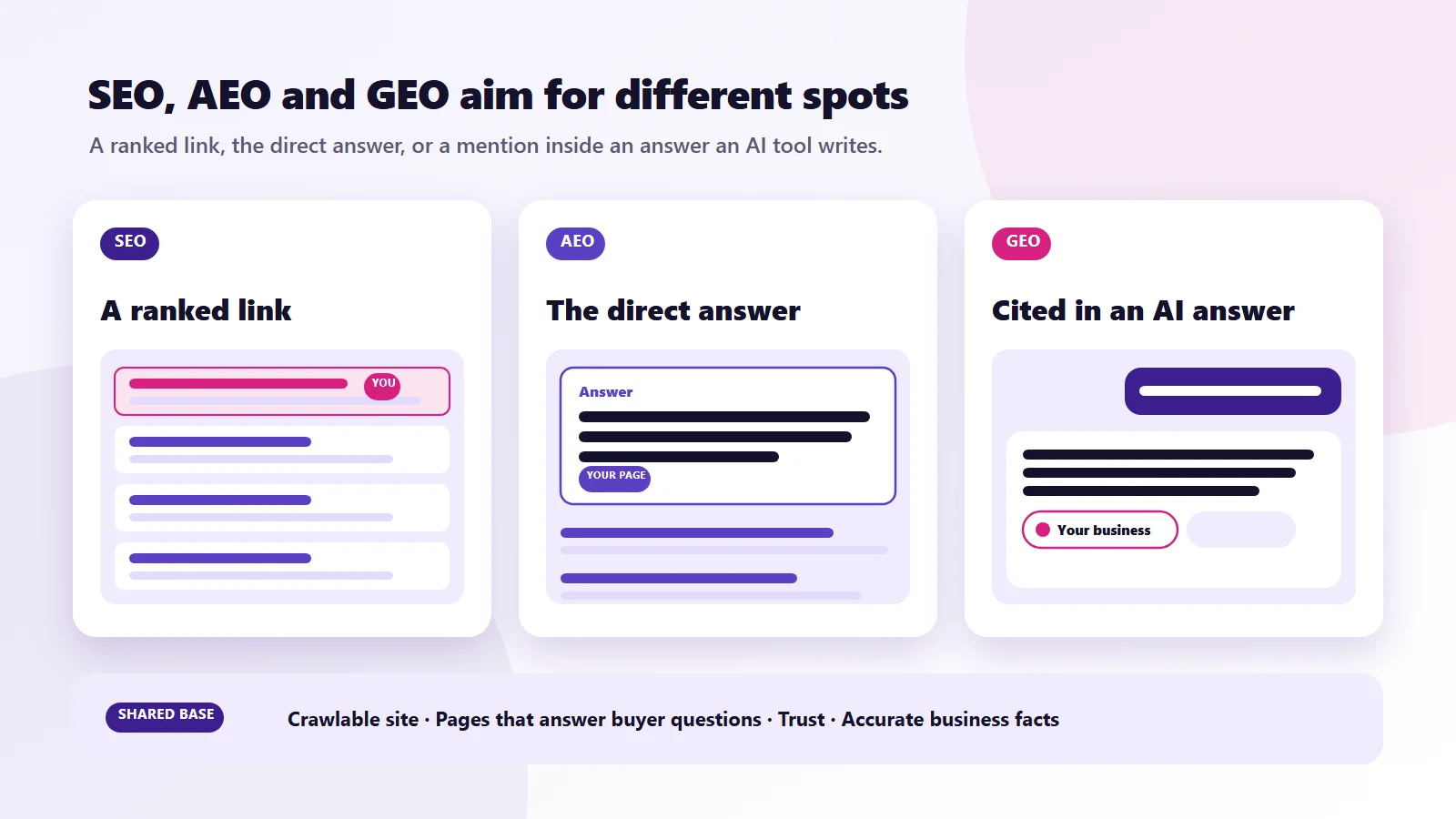
- SEO aims for a ranked link, GEO for a mention or citation in an AI answer. AEO sits between them: being the direct answer to a question.
- Most of the work is shared: a crawlable site, clear pages that answer real questions, and a trusted reputation.
- GEO adds three things: answers written to be quoted, mentions on other sites AI tools read, and tracking of AI referral visits.
- "GEO" is also used for geographic or local SEO. Check which one an agency means before you buy.
Search "GEO vs SEO" and you get three different topics: AI search, local SEO and geo-targeted ads. This guide is about the first one, and it compares all three terms you will hear from agencies: SEO, AEO and GEO.
It is written for small and mid-sized businesses in the US and UK that already get some traffic from Google and want to know what, if anything, they need to do differently for AI answers.
GEO vs SEO vs AEO at a glance
| SEO | AEO | GEO | |
|---|---|---|---|
| Goal | Rank a page high enough that people click it | Be the direct answer to a specific question | Be named, quoted or cited when an AI tool writes an answer |
| Where you show up | Google and Bing results pages | Featured snippets, People Also Ask, voice assistants, AI Overviews | ChatGPT, Gemini, Perplexity, Copilot, and Google's AI Overviews and AI Mode |
| What is measured | Rankings, impressions, clicks, organic leads and sales | Snippets and answer boxes won, and clicks from them | Mentions and citations for your buyer questions, AI referral visits, and what those visitors do |
| Main signals | Relevance, links, technical health, page experience | A short, clear answer near the top of the page, with headings, lists and schema | Quotable answers, consistent facts about your business, mentions on sites AI tools trust, pages that already rank |
| Timeline | Early movement in two to three months, stronger results in six to twelve | Similar to SEO, sooner on pages that already rank | Similar to SEO; pages that already rank well tend to get picked up sooner |
What is generative engine optimization?
Generative engine optimization is the work of making your business easy for AI tools to find, understand and recommend. A "generative engine" is any tool that writes an answer instead of only listing links: ChatGPT, Gemini, Perplexity, Microsoft Copilot, and Google's AI Overviews and AI Mode.
When someone asks one of these tools "which course is best for IT jobs for freshers" or "best accountant for a small business in Leeds", the tool draws on pages it can read and on what other sites say about each option. GEO aims to make your business one of the options it names, and to make sure it describes you correctly.
AEO (answer engine optimization) is an older, narrower idea: structure a page so a search engine can lift one answer from it, as in a featured snippet. Many agencies now use AEO and GEO to mean the same thing. What matters is the work, not the label.
What stays the same
Most of what works for SEO also works for GEO. AI tools that search the web lean on the same pages that search engines rank, so the base does not change:
- A site that can be crawled. If search engines and AI crawlers cannot load your pages, nothing else matters. Check that your robots.txt does not block the crawlers you want, and that key content is in the page HTML.
- Pages that answer what buyers ask. One clear page per service, product type or question, written in the words your customers use.
- Trust. Real reviews, named people, clear contact details, and links and mentions from other reputable sites.
- Accurate business facts. The same name, address, prices and service list everywhere they appear.
If your SEO is weak, start there. GEO is built on top of it, not instead of it.
What changes
Three things are new, or matter much more than before:
- Write answers to be quoted. Put a short, direct answer near the top of each page, then the detail. Use headings that match real questions, tables for comparisons, and plain numbers with their source. An AI tool can only quote what it can lift cleanly.
- Earn mentions, not only links. AI tools form a view of your business from what others write: reviews, directories, industry lists, forums, news and partner pages. A mention without a link still helps.
- Measure a new channel. Success is no longer only a ranking. You track whether you are named for your buyer questions, and how many visits arrive from AI tools.
Here is what that looks like for a real client. Teknowell, an IT training company, is cited in Google's AI Overview for "which course is best for IT jobs for freshers", and ChatGPT and Gemini cite its guides.
Teknowell, a SocialPulse Hub client, cited in Google's AI Overview
GEO can also mean local SEO
Some people use "GEO" for geographic SEO: ranking in a city or region, in the Google map pack, or for "near me" searches. Others use it for geo-targeting in ads. Neither is the same as generative engine optimization.
The two do overlap. When someone asks an AI tool for a local business, it often draws on Google Business Profile details, reviews and local directory listings, which is classic local SEO work. If an agency quotes you for "GEO", ask one question: do you mean AI answers, local search, or both?
How to measure GEO
You can measure most of it with tools you already have:
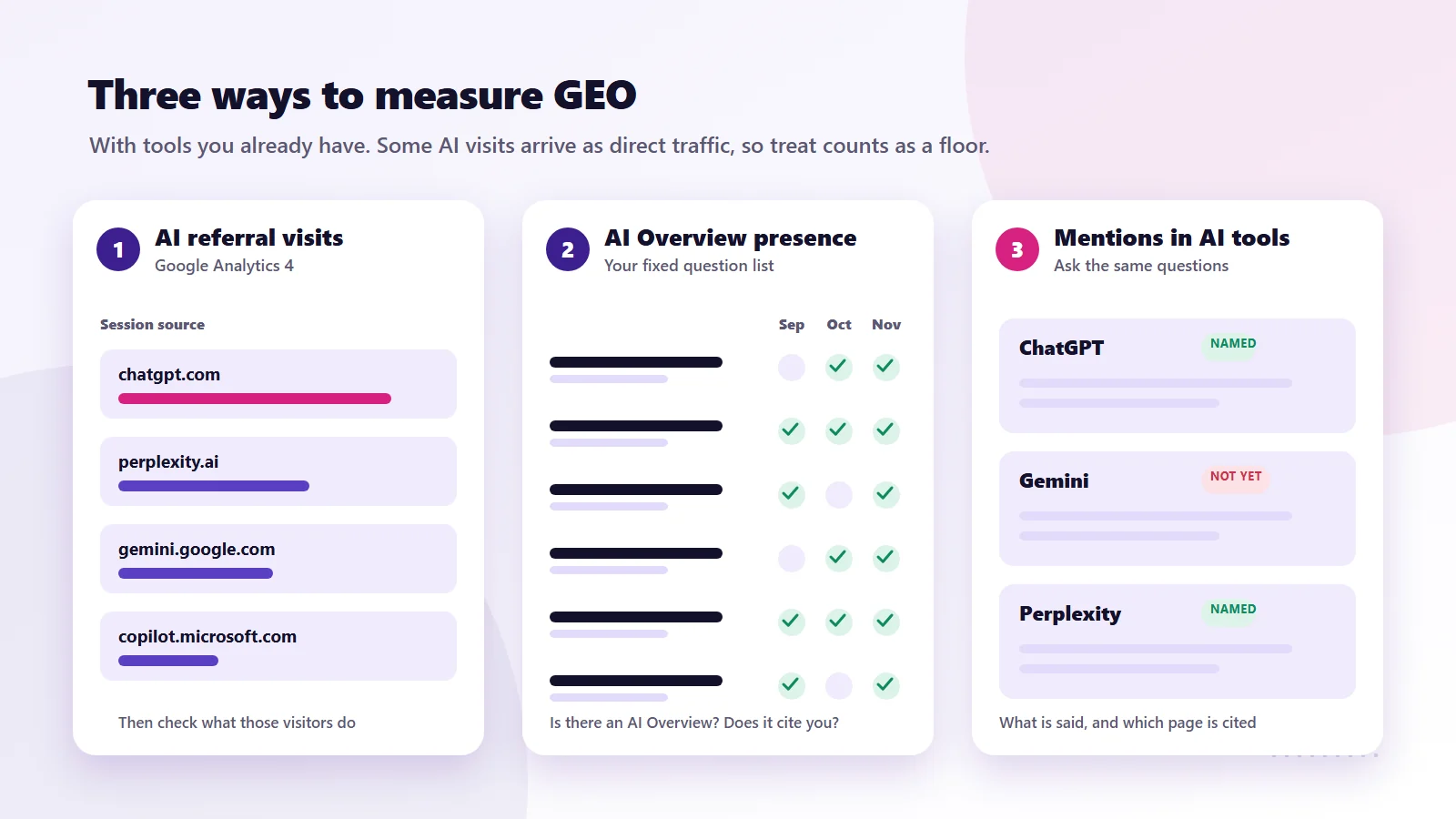
- AI referral visits in Google Analytics 4. Open Reports, then Acquisition, then Traffic acquisition, and set the dimension to Session source. Look for chatgpt.com, perplexity.ai, gemini.google.com and copilot.microsoft.com. Then check what those visitors do: time on site, enquiries and sales.
- AI Overview presence. Search Console counts AI Overview clicks and impressions inside your normal web search totals, but does not split them out. So keep a fixed list of 20 to 30 buyer questions and check each month whether an AI Overview appears and whether it cites you.
- Mentions in AI tools. Ask the same buyer questions in ChatGPT, Gemini and Perplexity each month. Note whether you are named, what is said about you, and which pages are cited.
Some AI visits arrive with no referrer and show up as direct traffic, so treat these numbers as a floor, not a full count.
What is AI search worth to you?
Use your own numbers. The share from AI answers is your assumption, not a benchmark, so try a low and a high figure.
A plan that does both
You do not need two teams or two budgets. This is the order we work in:
- Fix the base. Crawling, indexing, page speed and accurate business facts across your site and profiles.
- List your buyer questions. The 20 to 30 questions customers ask before they buy, taken from sales calls, reviews, Search Console and People Also Ask.
- Answer each one on the right page. A direct answer first, then the detail, with clear headings, tables and schema markup where it fits.
- Build mentions. Reviews, relevant directories, industry lists, partner pages and expert comment in trade press.
- Measure monthly. Rankings and clicks for SEO; AI referral visits and your question list for GEO. Keep what works and drop what does not.
If you are comparing agencies for this work, our guide to the best AI SEO agencies covers who suits which business and what they charge. Or see how we run AI search optimisation for our own clients.
Frequently asked questions
What is the difference between GEO and SEO?
SEO aims to rank your pages in search results so people click through. GEO, or generative engine optimization, aims to get your business named, quoted or cited inside answers written by AI tools such as ChatGPT, Gemini, Perplexity and Google's AI Overviews. Most of the groundwork is shared.
What is generative engine optimization?
It is the work of making your business easy for AI tools to find, understand and recommend: clear answers near the top of your pages, consistent facts about your business, mentions on other trusted sites, and tracking of visits that come from AI tools.
Is GEO replacing SEO?
No. AI tools that search the web lean on the same pages search engines rank, so strong SEO is the base GEO is built on. Treat GEO as an extra layer of work on top of SEO, not a replacement for it.
What is the difference between AEO and GEO?
AEO, or answer engine optimization, started as structuring a page so a search engine could lift one direct answer from it, as in a featured snippet. GEO covers being cited by AI tools that write whole answers. Many agencies now use the two terms for the same work.
Does GEO mean local SEO?
Sometimes. GEO is also used for geographic SEO, such as ranking in the map pack or for near me searches, and for geo-targeted ads. If an agency offers GEO, ask whether they mean AI answers, local search or both.
How do I measure GEO results?
In Google Analytics 4, check referral visits from chatgpt.com, perplexity.ai, gemini.google.com and copilot.microsoft.com, and what those visitors do. Keep a fixed list of buyer questions and check each month whether AI Overviews and AI tools name or cite you. Some AI visits show as direct traffic, so treat the numbers as a floor.
Have a question about this guide or your own setup? Contact us and our team will get back to you.